Delhi's Good or Satisfactory days drop to 63 from 79; AQI 500 station-days climb to 68 from 37
Delhi's air on CPCB's own record, 1 January to 3 November 2026 against the same window of 2025.
From 1 January to 3 November 2026, CPCB's 4 PM bulletin put Delhi in the Good or Satisfactory band on 63 days, against 79 days in the same window of 2025.1 That is 16 fewer days in CPCB's two cleanest bands, a fall of 20.3 per cent.1 Over the same window, Delhi's monitoring stations reached AQI 500, the top of CPCB's scale, on 68 station-days, against 37 in 2025.2
In this report: Fewer days in CPCB's two cleanest bands; More station-days at AQI 500; How these figures were counted.
Fewer days in CPCB's two cleanest bands
Delhi had 63 Good or Satisfactory days from 1 January to 3 November 2026, which is 16 fewer than the 79 of 2025.1 A day counts here when CPCB's 4 PM bulletin printed a Delhi AQI of 100 or less, which covers CPCB's Good band (0 to 50) and its Satisfactory band (51 to 100).1 The 2026 count is also lower than the 68 days of 2022 and the 66 days of 2024.1
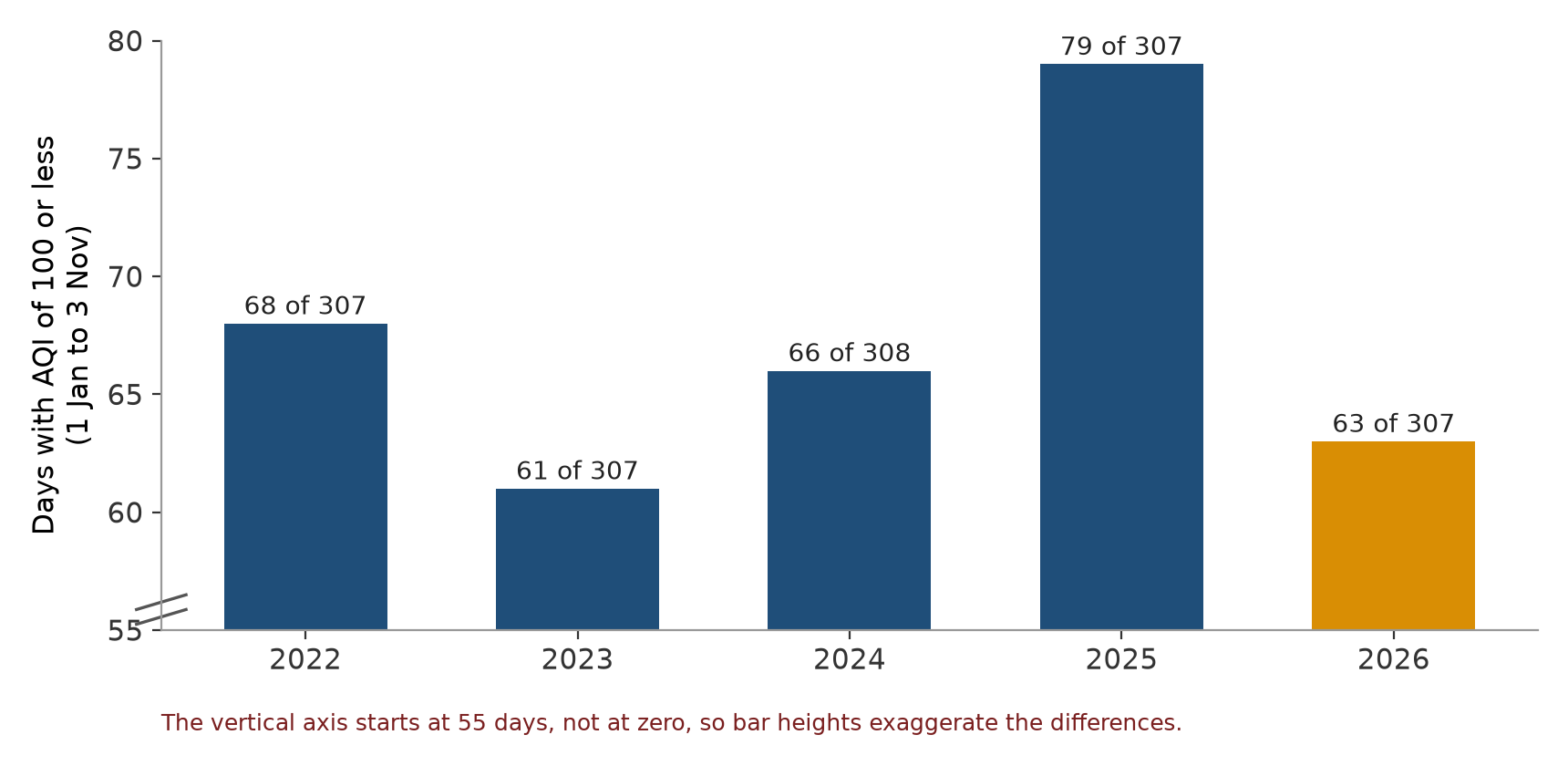
Each bar counts the days on which CPCB's bulletin put Delhi at AQI 100 or less, between 1 January and 3 November of that year.1 The axis runs from 55 to 80 days, and the count is printed on every bar.1
The window is the same in every year: 1 January to 3 November, which is 307 days, or 308 in 2024 because of 29 February.1
More station-days at AQI 500
A station-day is one monitoring station on one date. Delhi's stations reached AQI 500, the highest value CPCB's scale displays, on 68 station-days from 1 January to 3 November 2026, against 37 in the same window of 2025.2 As a share of every station-day with enough data for an AQI, that is 0.51 per cent in 2026 against 0.32 per cent in 2025.2 The 2026 share is 1.61 times the 2025 share.2
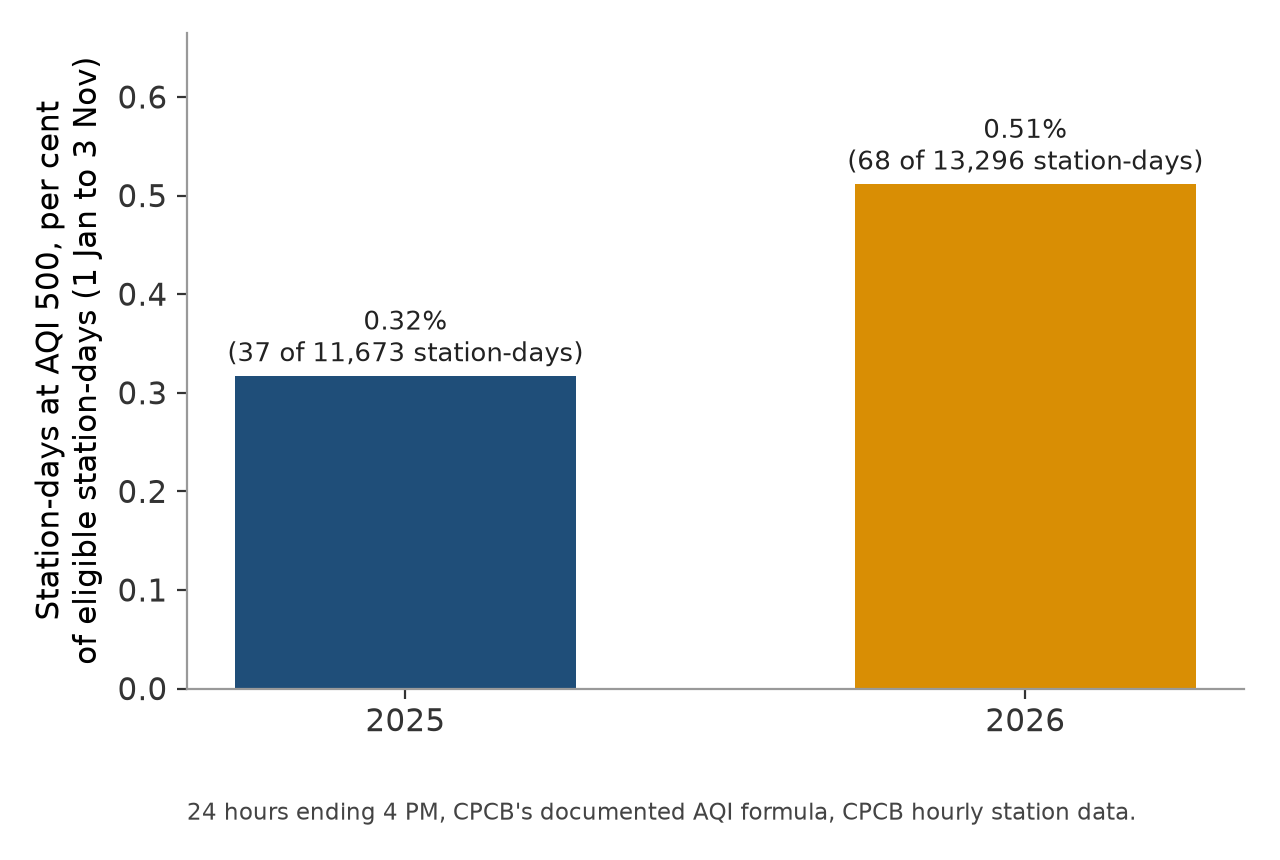
Each bar is the share of station-days, with enough data for an AQI, on which a Delhi station's AQI reached 500: 37 of 11,673 in 2025 and 68 of 13,296 in 2026.2 Both years cover 1 January to 3 November, on the 24 hours ending at 4 PM.2
The rise holds on the same stations. On the 38 stations that had 200 or more days with an AQI in both years, AQI 500 was reached on 67 station-days in 2026 against 36 in 2025, a share of 0.60 per cent against 0.32 per cent.3
The count set by fine particles alone also rose. The PM2.5 sub-index, which is the part of the AQI set by PM2.5 alone, reached 500 on 31 station-days in 2026, against 11 in 2025.4
| AQI 500, 1 January to 3 November2 | 2025 | 2026 |
|---|---|---|
| Station-days with enough data for an AQI | 11,673 | 13,296 |
| Station-days at AQI 500 | 37 | 68 |
| Share at AQI 500 | 0.32 per cent | 0.51 per cent |
| Same 38 stations: station-days at AQI 500 | 36 | 67 |
| Same 38 stations: share at AQI 500 | 0.32 per cent | 0.60 per cent |
| PM2.5 sub-index at 500 by itself | 11 | 31 |
The table sets each 2025 count against its 2026 count, for the whole network and for the same 38 stations.234
How these figures were counted
The days. Each day's figure is the Delhi city value in CPCB's 4 PM AQI bulletin, which CPCB works out as the average of the stations' AQI over the previous 24 hours. Every day from 1 January to 3 November in each year was read from CPCB's bulletin and checked against the bulletin's own PDF, except 1 January 2025, which was checked against CPCB's yearly city record because no bulletin PDF was at hand for it.1
The station-days. The station figures come from CPCB's hourly readings at each Delhi station, as archived by the Centre for Research on Energy and Clean Air (CREA). The AQI of each station-day was worked out with CPCB's published AQI method, over the 24 hours ending at 4 PM, which is the bulletin's own window.2 A station-day has enough data for an AQI when at least three pollutants, one of them PM2.5 or PM10, each have at least 16 valid hours in those 24 hours. The AQI is the highest of the pollutants' sub-indices, capped at 500 and rounded to a whole number.2
The same 38 stations. These are the stations that had 200 or more days with an AQI in the 2025 window and again in the 2026 window, so the comparison holds the stations fixed.3
The PM2.5 count. It takes station-days whose PM2.5 sub-index was 500 or more before rounding.4
- Central Pollution Control Board (CPCB), daily AQI bulletin for Delhi at 4 PM, every day from 1 January to 3 November in each year from 2022 to 2026, with CPCB's yearly city AQI record for 1 January 2025. Counted 3 November 2026.
- CPCB, hourly readings at each Delhi monitoring station, 1 January to 3 November 2025 and 2026, as archived by CREA; AQI worked out with CPCB's published AQI method over the 24 hours ending 4 PM. Counted 3 November 2026.
- CPCB hourly station readings as in note 2, limited to the 38 stations with 200 or more days with an AQI in both the 2025 and the 2026 window. Counted 3 November 2026.
- CPCB hourly station readings as in note 2. Station-days whose PM2.5 sub-index was 500 or more before rounding, 1 January to 3 November 2025 and 2026. Counted 3 November 2026.